
Walk into any refrigerated distribution center and the first thing you notice isn’t the cold — it’s the condensation. Every time a forklift rolls through a dock door, moves from a 34°F cooler into a 90°F loading yard, and back again, it drags a cloud of moisture with it. That moisture settles on every cold metal surface in the building, including the battery compartment underneath the operator’s seat.
For a lead-acid battery, that’s a nuisance. For a lithium battery with a poorly sealed enclosure, it’s a warranty claim waiting to happen. This is exactly why the IP67 rating shows up in nearly every spec sheet for industrial forklift batteries — and exactly why procurement teams need to understand what that rating actually guarantees, and what it doesn’t.
This guide breaks down the IP code system, explains why cold storage environments are uniquely punishing on battery enclosures, and shows what to look for on a spec sheet before you commit a six-figure fleet conversion budget to a supplier’s marketing claim.
What an IP Rating Actually Means
IP stands for Ingress Protection (sometimes called International Protection). It’s a two-digit code defined by the international standard IEC 60529, maintained by the International Electrotechnical Commission, and it exists specifically to replace vague marketing language like “waterproof” or “sealed” with a testable, verifiable claim.
Each digit in the code measures a different kind of protection:
| Digit Position | What It Measures | Scale |
|---|---|---|
| First digit | Protection against solid objects (dust, debris, fingers, tools) | 0 (no protection) to 6 (completely dust-tight) |
| Second digit | Protection against liquid ingress (drips, sprays, jets, immersion) | 0 (no protection) to 9K (high-pressure, high-temperature wash-down) |
So when a spec sheet reads IP67, it’s telling you two specific, testable facts:
- The “6” means the enclosure is fully dust-tight. No ingress of dust at all under the standard test conditions — not “resistant to,” but a complete seal against solid particulate.
- The “7” means the enclosure can withstand temporary immersion in up to 1 meter of fresh water for up to 30 minutes without water intrusion.
Compare that to the ratings you’ll commonly see on consumer-grade or lower-cost industrial equipment:
| Rating | Dust Protection | Water Protection | Typical Use Case |
|---|---|---|---|
| IP54 | Protected against dust ingress (not fully dust-tight) | Protected against splashing water from any direction | Indoor equipment, light-duty environments |
| IP65 | Fully dust-tight | Protected against low-pressure water jets | Golf cart batteries, outdoor consumer electronics |
| IP67 | Fully dust-tight | Protected against temporary immersion (1m, 30 min) | Forklift batteries, AGVs, industrial floor equipment |
| IP68 | Fully dust-tight | Protected against continuous immersion beyond 1m (depth/duration manufacturer-defined) | Marine equipment, subsea sensors |
It’s worth noting that IP68 isn’t automatically “better” for a forklift application — it typically implies sustained submersion capability that a warehouse battery will never actually need, while adding cost. IP67 is the rating that matches the real-world exposure profile of a battery living inside a forklift’s battery compartment: dust-tight always, and unaffected by the kind of standing water, condensation pooling, and splash exposure that a cold storage floor produces daily.

Why Cold Storage Is a Uniquely Hostile Environment for Battery Enclosures
Every warehouse exposes equipment to some dust and moisture. Cold storage and refrigerated distribution facilities compound the problem in three specific ways that don’t exist in a typical dry warehouse.
1. Condensation from temperature cycling. Forklifts operating in cold storage rarely stay in one temperature zone. A typical shift involves repeated transitions between a 28–36°F cooler, a loading dock at ambient temperature, and sometimes an outdoor yard. Every transition causes moisture in the air to condense on any surface colder than the surrounding air — including battery terminals, connector housings, and BMS circuit boards if the enclosure isn’t sealed against it.
2. Wash-down and sanitation protocols. Food-grade cold storage facilities are subject to strict sanitation requirements, and floors are frequently hosed down or cleaned with pressurized water and cleaning agents. A battery sitting in its compartment low to the ground will encounter standing water and spray on a routine basis — not as an edge case, but as a daily operating condition.
3. Ice and frost accumulation. In freezer environments specifically (0°F and below), any moisture that does find its way past a weak seal doesn’t just sit there — it freezes, expands, and can damage internal connections or crack housings over repeated cycles.
None of these conditions are exotic. They’re the baseline operating reality of a refrigerated distribution center, which is why OSHA’s warehousing safety guidance treats cold storage as its own hazard category with distinct engineering and equipment considerations, separate from standard dry warehousing. A battery enclosure rated for a dry ambient warehouse simply isn’t specified for this environment, regardless of what the cycle-life or capacity numbers on the same spec sheet look like.
What IP67 Protects Inside a Forklift Battery
An IP67 rating isn’t a single seal — it’s a rating for the entire enclosure system working together. Inside a well-built forklift battery, that includes:
- The battery management system (BMS) — the circuit board responsible for cell balancing, overcharge/over-discharge protection, and temperature monitoring. Moisture intrusion here is often what actually kills a battery, not the cells themselves.
- High-current connector interfaces — connection points like SB350 or Anderson-style connectors that carry hundreds of amps and must remain free of corrosion and moisture bridging.
- The LCD display and communication ports — increasingly common on modern industrial batteries for real-time state-of-charge and diagnostic readouts, these are exactly the kind of small apertures that a weak seal fails to protect.
- Cell-to-cell busbars and terminals — exposed metal-to-metal connections that corrode rapidly once moisture and dust combine.
A dust-tight, moisture-sealed enclosure protects all of these simultaneously. This is also why IP67 should be understood as a floor requirement rather than a bonus feature when evaluating batteries for cold storage or wash-down duty — a battery without it isn’t a lesser option, it’s frequently an inappropriate one for the environment.
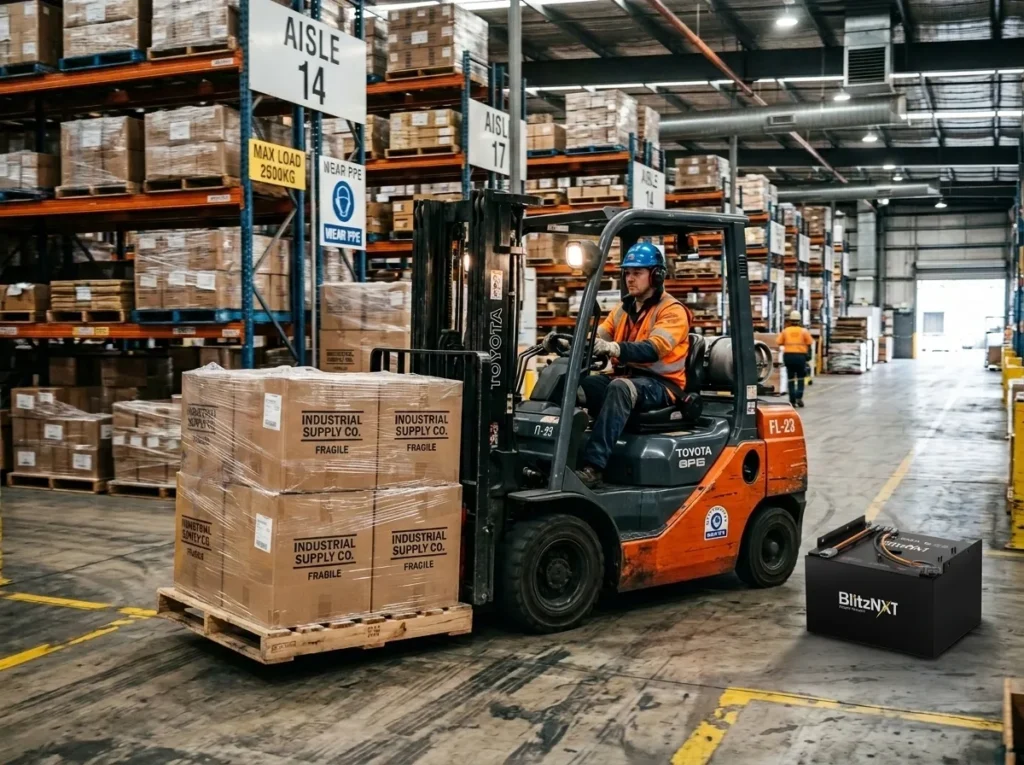
BlitzNXT LiFePO4 Forklift Batteries: IP67 by Design
BlitzNXT’s forklift battery line is built specifically for warehouse and cold storage duty, and IP67 protection is a baseline spec across the range rather than a premium add-on. Using the BlitzNXT 51.2V 460Ah LiFePO4 forklift battery as a representative example, here’s how the sealing and temperature protection actually translate into published specifications:
| Spec | Value |
|---|---|
| Nominal Voltage / Capacity | 51.2V / 460Ah (23.6 kWh usable energy) |
| Waterproof Rating | IP67 — dust-tight, protected against temporary immersion |
| Shell Material | Black iron case, impact and vibration resistant |
| Discharge Temperature Range | -20°C to 50°C |
| Charge Temperature Range | 0°C to 45°C |
| Storage Temperature Range | 10°C to 30°C |
| Standard / Peak Discharge Current | 100A / 350A |
| Cycle Life | 3,000+ cycles at 25°C ± 2°C, 0.2C/0.2C |
| Charge/Discharge Interface | REMA320, Anderson SB350-style |
| Cell Source | EVE Grade-A LiFePO4 cells |
| Warranty | 10 years |
Two details on that table matter specifically for cold storage operations. First, the -20°C discharge floor means the battery can continue powering a forklift inside a standard freezer zone without derating. Second — and this is a detail that’s easy to overlook — the battery’s BMS enforces an automatic low-temperature charge cutoff below 0°C. Charging a lithium cell below freezing causes cumulative, irreversible cell damage even when the pack still appears to accept a charge. By suspending charging automatically until the pack warms above that threshold, and resuming without operator intervention once it does, the BMS is protecting long-term capacity retention in exactly the swing conditions a cold storage forklift will experience shift after shift.
The full BlitzNXT forklift battery lineup carries this same IP67 sealing and wide operating range across capacities from 230Ah up to 920Ah and voltage classes from 24V to 72V, so fleets don’t have to trade sealing quality for the specific voltage or runtime configuration their trucks require.
What Happens When a Battery Isn’t Sealed for Cold Storage
It helps to understand the failure mode, not just the spec, because the way an under-sealed battery fails in a refrigerated facility is rarely dramatic. It’s gradual, and it’s expensive in ways that don’t show up on an invoice.
- Corroded connector contacts. Repeated condensation cycling on an unsealed or poorly gasketed connector introduces oxidation at the contact surface. Resistance climbs, the connection runs hotter under load, and charging times slowly extend — often written off as “the charger getting old” rather than diagnosed correctly.
- BMS sensor drift and false shutdowns. Moisture reaching a circuit board doesn’t always cause an instant failure. More often it causes intermittent faults — a temperature sensor reading incorrectly, a cell-balancing circuit tripping a protection state during a shift for no apparent reason. These are the failures that generate the most frustrating support calls, because they’re inconsistent and hard to reproduce on a bench.
- Accelerated capacity fade. If moisture reaches a cell terminal and triggers even minor internal corrosion, that cell’s effective capacity and internal resistance change relative to its neighbors. The BMS has to work harder to keep the pack balanced, and usable runtime declines faster than the rated cycle-life curve would predict.
None of these failures are visible on day one. They surface at month eight or month fourteen, well after the equipment has been accepted and put into daily rotation — which is exactly why the IP rating needs to be verified at purchase, not discovered as a root cause during a warranty dispute.
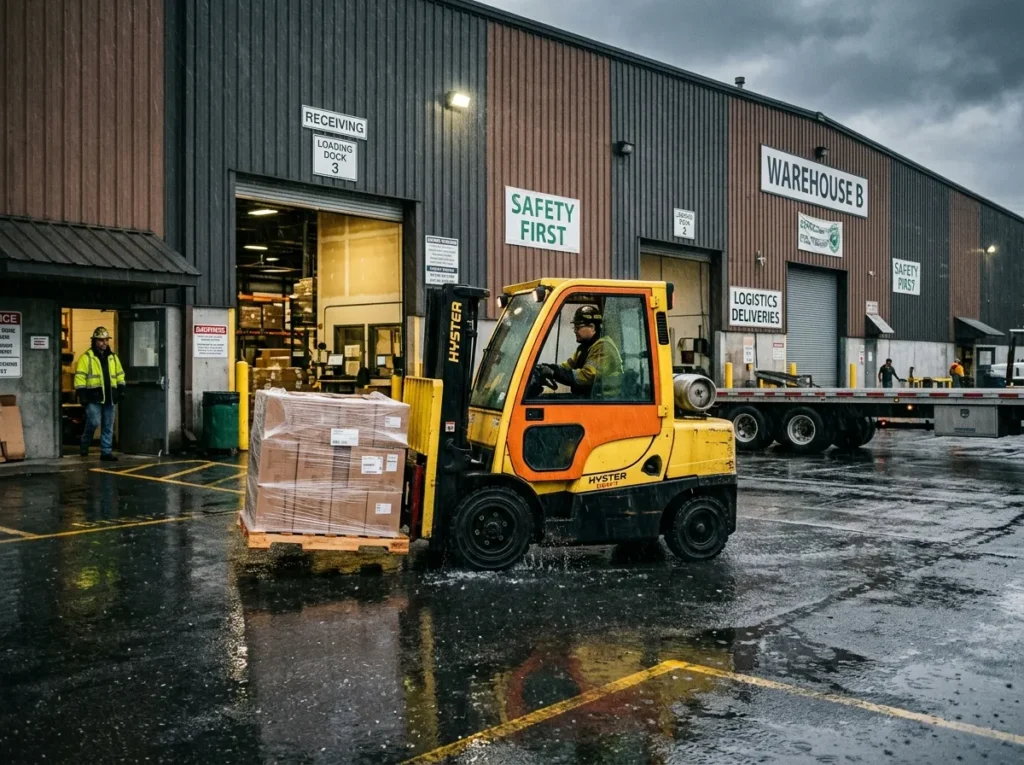
Lithium vs. Lead-Acid: The Cold Storage Case Is Even Stronger Than It Looks
Cold storage operations already have strong incentives to move off lead-acid, and the sealing question adds another layer to that math. Lead-acid batteries vent hydrogen gas during charging and require watering, equalization charges, and acid-level checks — maintenance tasks that are meaningfully harder to perform safely and consistently in a facility where workers are already managing cold-stress exposure limits and limited time in refrigerated zones. A sealed, maintenance-free lithium pack removes that maintenance burden from an environment where OSHA’s cold-stress guidance already recommends minimizing unnecessary time spent in refrigerated zones.
There’s also a performance dimension specific to cold environments. Lead-acid chemistry loses usable capacity as temperature drops — a battery that delivers a full shift at 70°F can lose a substantial share of that capacity at 20°F, right when a cold storage fleet needs it most. LiFePO4 chemistry is far less sensitive to this effect within its rated discharge range, which is why a -20°C discharge floor on a spec sheet is doing real operational work, not just serving as a marketing number.
| Factor | Lead-Acid in Cold Storage | Sealed IP67 LiFePO4 |
|---|---|---|
| Cold-weather capacity loss | Significant capacity drop below freezing | Minimal within rated discharge range (-20°C floor) |
| Maintenance in refrigerated zones | Watering, equalization, acid checks required | Zero routine maintenance |
| Moisture/condensation exposure | Vented design, corrosion-prone terminals | Fully sealed IP67 enclosure |
| Charging in sub-zero conditions | Reduced charge acceptance, damage risk | Automatic charge cutoff protects cells until safe |
| Operator time in cold zones for upkeep | Recurring | Effectively none |
Taken together, the sealing question isn’t separate from the total cost of ownership conversation — it’s one of the core inputs into it. A battery that can’t keep moisture out of its BMS in a wash-down environment will underperform its rated cycle life regardless of how strong that rating looks on paper, which turns an apparent capital savings on a lower-rated battery into a higher effective cost per operating hour once early failures and replacement cycles are factored in.
Beyond the Rating: What Else to Check Before You Buy
An IP67 badge on a spec sheet is a necessary detail, but it isn’t sufficient on its own to guarantee cold-storage performance. Buyers evaluating forklift lithium batteries for cold environments should confirm the following as a package:
- Discharge temperature floor. Confirm the published number (ideally -20°C or lower) and whether it applies to the whole operating range or only a reduced-output mode.
- Automatic low-temperature charge protection. Ask specifically whether the BMS cuts off charging below freezing and resumes automatically, rather than requiring manual reset.
- Real cycle-life data at stated test conditions. Cycle-life figures should specify the temperature and C-rate they were tested under — numbers without conditions attached are effectively unverifiable.
- Connector and interface compatibility. Confirm the physical connector standard (REMA, Anderson/SB-series, etc.) matches your existing fleet charging infrastructure before assuming a drop-in replacement.
- Documented certification, not just a printed number. Ask the supplier for test documentation or third-party verification behind the IP67 claim, since the rating is self-certified by manufacturers under IEC 60529 rather than independently policed on every unit sold.
For a broader walkthrough of how IP rating fits alongside voltage, capacity, BMS quality, and total cost of ownership when converting a fleet, see our detailed guide on how to choose a forklift lithium battery. And once a lithium battery is in service, following basic care practices extends its working life significantly — our LiFePO4 battery maintenance guide covers charging habits, storage conditions, and monitoring routines specific to forklift and golf cart fleets.
It’s also worth remembering that IP ratings only describe protection against ingress — they say nothing about a facility’s broader safety obligations around cold exposure for the operators driving these trucks. NIOSH and OSHA’s cold stress guidance referenced earlier is a useful resource for facilities building out safety protocols alongside their equipment upgrades, since a sealed, cold-rated battery is only one part of a safe cold storage operation.
Ready to Move Your Cold Storage Fleet to Sealed, Cold-Rated Lithium?
BlitzNXT’s IP67-rated LiFePO4 forklift batteries are engineered with automatic low-temperature protection, a -20°C discharge floor, and a 10-year warranty backed by US-based support out of our Humble, TX warehouse. Whatever your fleet’s voltage or capacity needs, we can match it. Contact our team today for a fleet consultation and a quote built around your exact cold storage operation.